

Last Friday night, we were captivated by watching the return to Earth of the Artemis II astronauts from their mission around the Moon. It led us to spend part of the weekend contemplating something larger than ourselves.
Actually, it’s our place in two different universes that we’re still thinking about.
The first was where four human beings traveled farther from this planet than anyone has ever gone before. They saw what few have ever seen in witnessing that side of the Moon that perpetually faces away from us. They explored that expanse that we call “the final frontier.” For those of us of a certain age, it was very reminiscent of that heady time when an American President pledged that we would go to the Moon within a decade — and we did.
Consider the moment in 1961 when President John F. Kennedy first challenged the nation to put a man on the Moon. Speaking before a joint session of Congress and having been elected just six months prior, the young president said: “I believe that this nation should commit itself to achieving the goal, before this decade is out, of landing a man on the moon and returning him safely to the Earth.”
At that very moment, television itself was still in its first decade for much of the country.
Kennedy would explain why reaching the Moon was imperative. In a 1962 speech at Rice University, he delivered these words: “We choose to go to the moon in this decade, and do the other things — not because they are easy, but because they are hard; because that goal will serve to organize and measure the best of our energies and skills; because that challenge is one that we are willing to accept; one that we are unwilling to postpone, and one we intend to win.”
Of course, we did answer that challenge before the end of the decade. The Apollo missions put a total of twelve men on the Moon, beginning in 1969 and ending just three years later, in 1972.
But we hadn’t been back since.
So to see four astronauts, including a woman, blast off from Cape Canaveral aboard an SLS rocket, circle the Moon, then return to Earth and successfully splash down in the Pacific was both a nostalgic moment and a triumphant return to the idealistic goal of scientific exploration. A recapturing, if perhaps for only a moment, of some hope and pride for many of us.
No image depicts our small place in the universe quite like the one the Artemis astronauts captured of Earth from afar. It is reminiscent of the iconic “Blue Marble” photo taken from Apollo 17 in 1972. Controversy emerged on social media over the new imagery from the Artemis II mission, with some wondering why the new pictures appear less sharp than those taken over five decades ago.
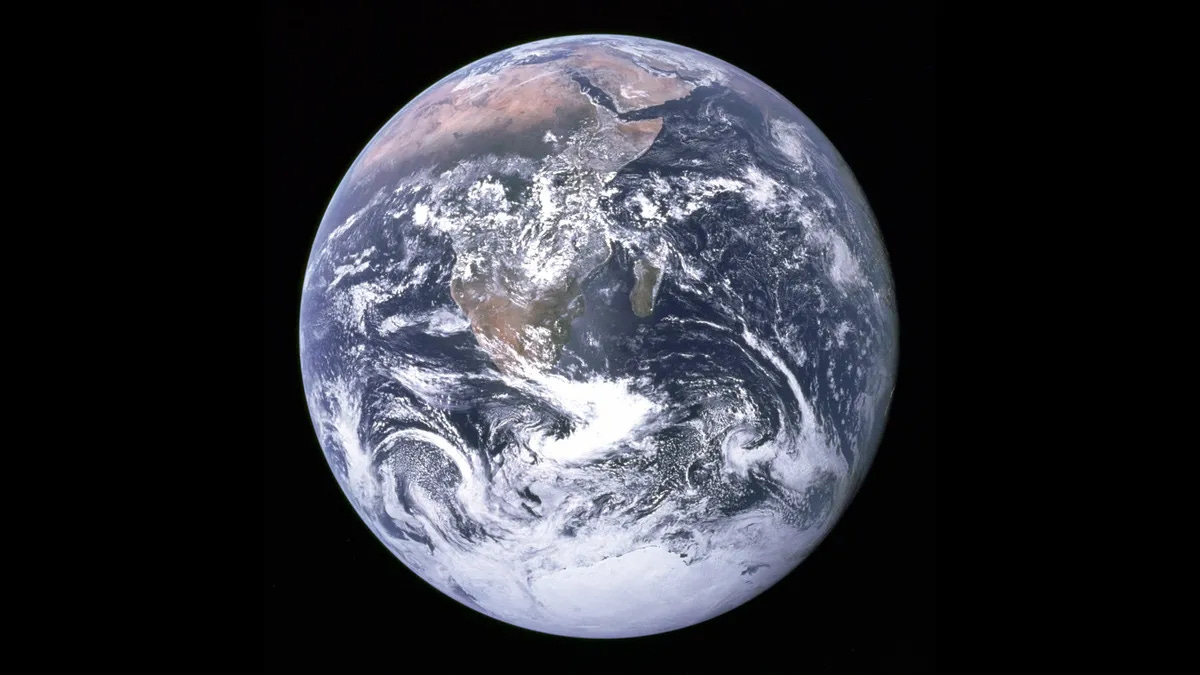
(Image taken by Harrison Schmitt aboard Apollo 17 in 1972. Photo Credit: NASA)
We contrasted those images in our minds with a very different one we saw over the weekend. That image is this map of the “media universe” as created by Evan Shapiro, the self-described “official unofficial cartographer” of the media.
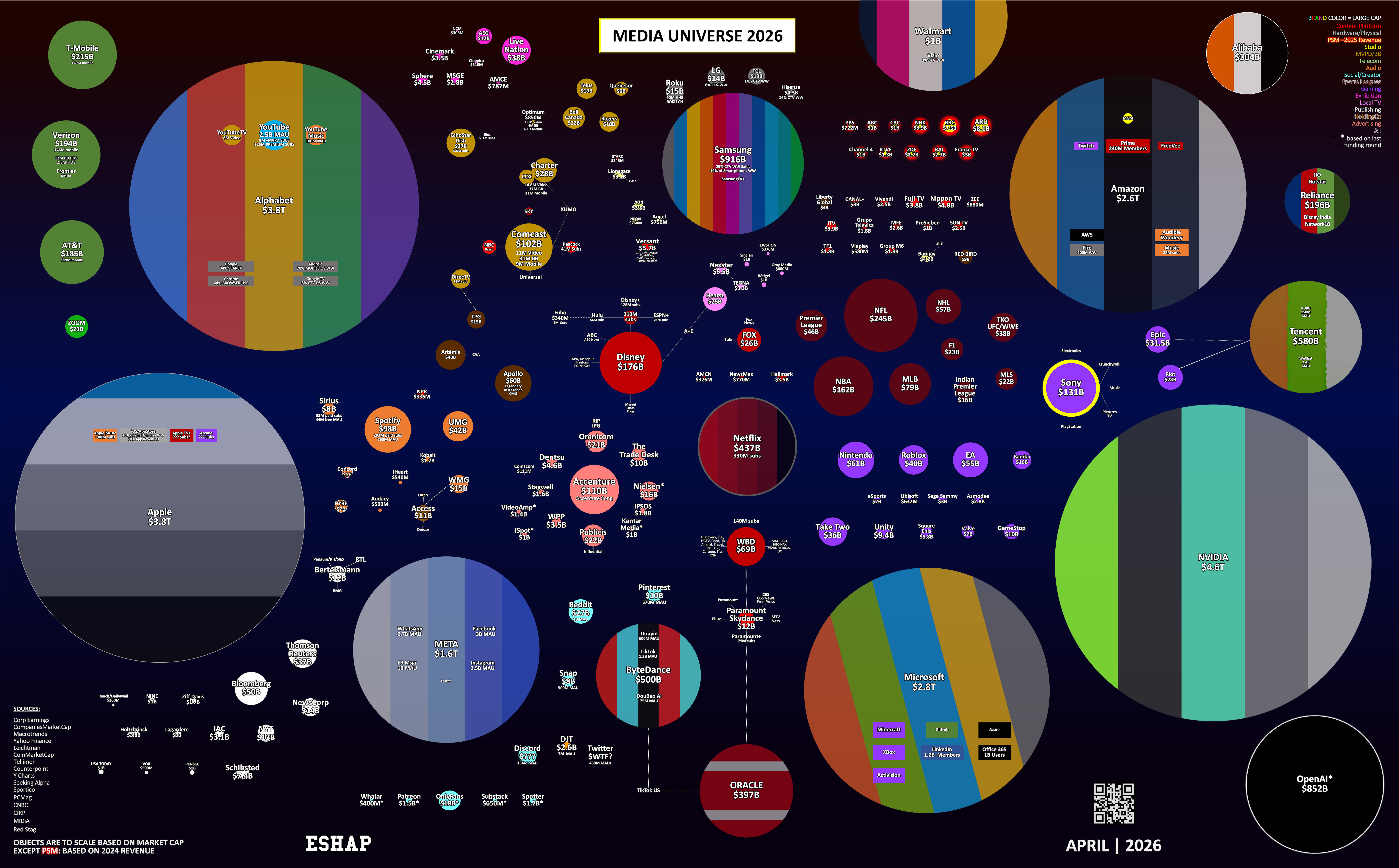
(Image courtesy of Evan Shapiro’s Substack: “Media War & Peace.” Please visit his publication to see this in greater detail by clicking here.)
Shapiro’s latest mapping effort reminds us of how small a space television occupies, especially at the local level, in the current state of the “universe” encompassing all media. In a “solar system” where the Jupiter-sized planets, at least as measured by their value, have names like Amazon, Apple, Alphabet (Google), Meta, Microsoft, and Nvidia, (each being measured in Trillions of dollars) the likes of Nexstar, TEGNA, and Sinclair are more like Mercury-sized in this universe, given that their value is measured in mere Billions. Smaller players like Gray and Scripps, with their value in the millions, are but specks on the map. (If you are having a hard time finding them, locate Netflix in the center and look “due North” (straight up) from there.)
Searching through this map of the media universe, we’re reminded that even if Nexstar eventually completes its acquisition of TEGNA, it will still be considerably smaller (in value) than Hearst, which has other significant media holdings beyond its portfolio of 35 local television stations.
Frankly, if Nexstar’s lawyers wanted to convince any federal judge of the veracity of the argument they are making that the survival of local television station owners pitted against the technology giants dictates that they grow in size and scope, they should have Evan Shapiro’s map made into a giant poster and bring it to every courtroom they appear in.
Our comparison between the universe our small and fragile planet exists in and the “universe” our media exists in is undoubtedly imprecise and perhaps inelegant. But examining the two does provide, at the very least, some perspective on the changes that seem to be perpetually going on within each, and the challenge to explore what’s next in both realms.
It is also worth remembering that technology is merely a tool to help us explore the reaches of both known and unknown. No matter how sophisticated, technology cannot fully replace the human elements of inquiry and exploration that lead to understanding.
JFK’s words are still as prescient today as when he delivered them nearly 64 years ago at Rice University: “We set sail on this new sea because there is knowledge to be gained, and new rights to be won — and they must be won and used for the progress of all people.”
-30-