

Welcome to your unofficial start of fall. Yes, yes…we know it isn’t official until later this month—but with the return of football on both the college and professional level, and the end of the labor day weekend leading to a Tuesday that feels more like “a double dose of a Monday.” the summer of 2026 is already fading into being another set of memories.
Speaking of memories, we were reminded of a strong one over the weekend in the viewing of a particular network-owned station who appears to be quietly bringing back some branding from its once-glorious past.
Perhaps, a small but notable revolution could be getting underway.
The station in question is New England’s oldest, CBS-owned and operated WBZ-TV. When we dialed up their live stream late last week we saw the station utilizing its recently unveiled “virtual reality” set for its weather presentation in a newscast. Frankly, the whole “VR” thing is a bit of a yawner now, and the quality of the deployments across the CBS-owned stations that have built them is frankly, uneven and unexciting—at best.
But we noticed a couple of small changes while watching the ‘BZ live stream on our 85-inch television set, and we snapped a quick picture to make sure we weren’t hallucinating that it was forty years ago and the year was somehow 1986.
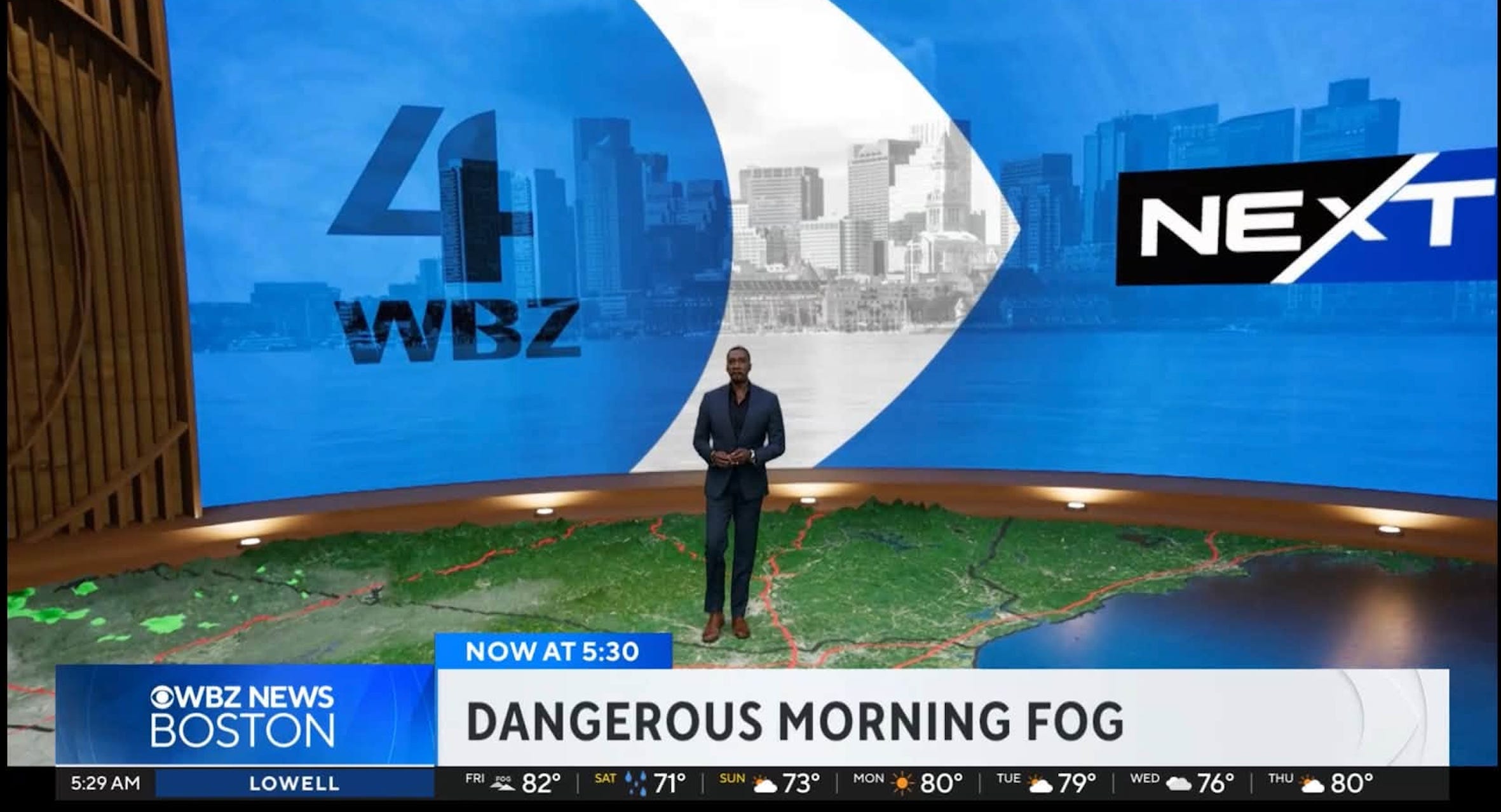
Behind the meteorologist is something that hasn’t made an appearance on the station in quite some time. It is that distinctive looking numeral “4” and the typeface for the letters “WBZ” that appear below it. That “look” hasn’t been on the air in decades, since not long after WBZ’s original owner, Westinghouse, took over all of CBS in 1995. That’s when WBZ, which had signed on the air as Boston’s NBC affiliate, became a CBS affiliate. (It had originally followed WBZ Radio’s longtime relationship with NBC as its radio affiliate there since the early 1930’s).
Westinghouse was a broadcasting industry leader from its launch of the nation’s first commercially licensed radio station, KDKA in Pittsburgh back in 1920, straight through to the company’s acquisition of CBS some 75 years later. In 1963, the industrial conglomerate moved to separate its broadcast holdings from the larger electrical manufacturing business, and so it rebranded “Westinghouse Broadcasting” into the catchier “Group W” as shorthand. Around the same time, it adopted a unique looking typeface, with sharp angles and deep grooves, that would be used across the broadcasting company and all of its radio and television properties, including WBZ in Boston.
After some research, we believe the name of the original “Group W” type designer has been lost to history. (If someone has better information, please do let us know.) The modern day typeface that is called “Anklepants” is a relatively faithful recreation of the original design, but it isn’t exactly the same in all aspects.
Why our obsession about something as specific as a typeface?
To be honest, we are somewhat nerdy about graphic design in general, and when we started our career in broadcasting, the Group W stations were known as some of the best in the business. WBZ-TV had been Boston’s dominant local station for news for decades at that point, and the station’s logo had been in place for well over a decade. (This was unusual because many stations changed their “look” multiple times in the decades they had been on the air at that point.) WBZ-TV stuck with the Group W typeface “4” for nearly 30 years, before ultimately ditching it for the first in a series of CBS mandated rebranding efforts since the mid-1990s.
The latest of those efforts arrived just three years ago. In 2023, the CBS News and Stations unit—under then President & CEO Wendy McMahon—decided to make all of the network’s owned stations extensions of the “CBS News” division, turning the long standing local brands into the more generic “CBS News (location)”. This turned WBZ 4 into “CBS News Boston” and relegated the historic three letter call sign into a small black and white box in the lower left corner of the television screen. The number “4” was erased from the station altogether. (In other markets with CBS-owned and operated stations, they were given the option of retaining either just their call letters or their channel number with the CBS “eye” logo attached.)
But this recent return, however subtle, of the historic “Group W” look to WBZ-TV may mean something more significant than just a nostalgic nod to the station’s history. In the photo above, there is another small clue of perhaps a more significant break with the network. One that seems to elevate local identity over the corporate one that has become so prevalent in the industry these days.
In the lower left of the photo, at the beginning of what is known as “the lower third” graphic along the bottom of the screen, you’ll note that it no longer says “CBS News Boston” as it did when we last saw the station a few months ago. Now, it shows “WBZ News Boston” along with a strategic CBS “eye” next to the WBZ call letters.
To us, that represents a potential major change in marketing strategy.
It signals that in the Boston television market, the importance of the WBZ brand is far more positive than that of “CBS News.” And these days, there should be little wonder as to why that might be true. Given the havoc that the 2025 arrival of owner Skydance, with its hungry-to-build-a-media-empire CEO David Ellison and his hand-picked leader for CBS News, Bari Weiss, have brought to “The House that Murrow Built,” there hasn’t been a lot that’s resonated with the audience. Both the network’s morning and evening news are distant thirds (or worse) in the network ratings battle. And everyone is holding their collective breaths to see what Ms. Weiss and her errand boy Nick Bilton with bring forth with their remake of “60 Minutes” when it debuts its 59th season this coming Sunday evening.
In the face of all that, it would be understandable that someone in the WBZ-TV studios on Soldiers Field Road in the Allston-Brighton section of Boston might want to recapture some of the greatness of channel 4 from decades past, while maybe tamping down the station being the local face of the crumbling CBS News legacy. But what makes the move a little more complicated is that WBZ-TV is overseen by “President and Regional General Manager” Johnny Green, who is actually based in CBS’s New York City headquarters, where he also oversees WCBS-TV, the CBS Owned station there.
Mr. Green would know the legacy at WBZ-TV first hand, he was the station’s news director from 2016 to 2020, before rising to a corporate position with CBS. During his time in Boston, CBS would sell off all of its radio stations in 2017, including WBZ radio at 1030 on the AM dial, to Entercom—which is now known as Audacy. But to get the deal approved by the FCC, Entercom had to sell off some stations. (This is back when the FCC actually cared about one company owning too many broadcast stations, something that isn’t much of an issue for the commission today.) Thus WBZ was among a handful of stations that were spun off to iHeart Radio, the largest owner of radio stations in the country.
Back to the present, we suspect that these changes that may be taking place at WBZ-TV are being done with the knowledge of its mostly-out-of-town leader. Though we also suspect that the experienced Johnny Green has limited how far the station can dig into the archives and bring back its past, until it either sees some significant positive results to justify those changes or someone at the network level realizes that there may be a small revolution brewing up in Boston.
And not one involving any kind of beer.
Of course, if there was any place you would want to start a real revolution, Boston would seem to be the best place to do so.
After all, the place has some notable experience with them.
-30-